Best humidifier for hard water: buy the type that leaves the minerals behind
We may earn a commission if you buy through these links — at no cost to you.
Honeywell HCM350B cool moisture humidifier
Evaporative: a fan pulls air through a wet wick, so the water evaporates and the minerals stay in the filter
This is the pick because of the mechanism, not the brand. Evaporative units cannot throw minerals into the room: the water leaves as vapour and the calcium stays behind in the wick, which is a consumable you replace a few times a season. Tap water is fine. That single property is what an ultrasonic unit cannot offer at any price, and it is why this is the default answer to 'my humidifier leaves white dust'.
Check the current price on Amazon ›Short answer: if your water is hard, stop buying ultrasonic humidifiers. An evaporative (wick) or warm-mist unit leaves the minerals behind in the machine instead of aerosolising them across the room — and the cartridge you were told to add to your ultrasonic unit is a subscription, not a fix.
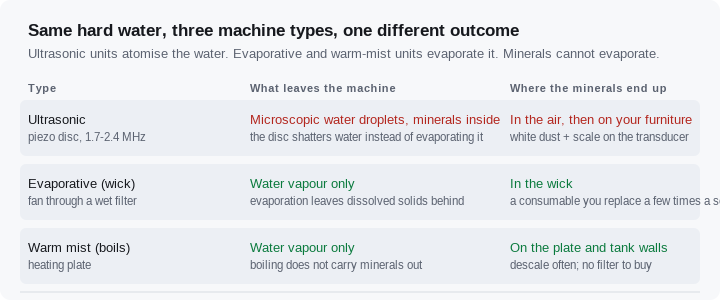
The mechanism, in one paragraph
An ultrasonic humidifier does not evaporate water. A piezoelectric disc vibrates at roughly 1.7 to 2.4 MHz and shatters the water into droplets a couple of microns across, which a fan then pushes into the room. Every dissolved mineral in that water rides along inside a droplet. The droplet evaporates in the air and leaves its calcium and magnesium behind as the fine white powder you are wiping off the bedside table — and, at the same time, as the crust inside the tank and around the transducer. The US Environmental Protection Agency’s own consumer fact sheet on humidifiers says the same thing plainly: ultrasonic and impeller units “create a cool mist by means of ultrasonic sound or a rotating disk” and are the types that disperse minerals from tap water into the air, while steam vaporisers and evaporative units are not expected to.
Evaporative and warm-mist units add energy instead of vibration. Evaporative units blow air through a saturated wick; warm-mist units boil the water. In both cases water leaves as vapour and the minerals are left in the wick, the tank or the heating plate. You still have to clean the machine — scale is scale — but the scale is inside the unit where you can see it, not on your furniture and in your lungs.
Step 1: measure your water before you buy anything
Hardness is a number you can read off your own tap in under a minute, and it is the only input that decides this purchase. A cheap digital TDS meter is the humidifier equivalent of a hygrometer: buy it first, because “hard water” as a feeling is useless and “my water reads 340 ppm” tells you exactly how bad the problem is going to be.
Two honest caveats on the number:
- TDS is not hardness. A total-dissolved-solids meter counts everything dissolved — sodium, chloride, sulphate — not only calcium and magnesium. It is a proxy, and a generous one.
- The proxy is still decisive at the ends. Below roughly 120 mg/L (which is the conventional boundary where water starts being classed as hard, and where many testers will already read a little higher) an ultrasonic unit produces light dust you may tolerate. Above roughly 250 to 300 ppm on a TDS meter, white dust is not a possibility, it is a certainty, and no in-tank cartridge will keep up with it for a full season.
If you want the real classification rather than a proxy, the US Geological Survey’s hardness scale is the standard reference: soft under 60 mg/L as calcium carbonate, moderately hard 61 to 120, hard 121 to 180, very hard above 180.
Step 2: choose the type — the decision table
| Type | White dust on tap water | Recurring consumable | Noise | Notes |
|---|---|---|---|---|
| Ultrasonic (cool mist) | Yes, in proportion to hardness | Cartridge if you add one, plus descaler | Quietest | The dust is the design, not a fault |
| Evaporative (wick) | No — minerals stay in the wick | Wick, a few times a season | Fan noise, audible at night | Cheapest structural fix; self-limiting, cannot over-humidify |
| Warm mist (boils) | No — minerals stay in the tank/plate | Descaler, more often | Kettle-ish, plus heat | Highest running cost; hot mist around children |
| Airwasher (rotating disks) | No — minerals stay in the water | None to buy; disks need cleaning | Very quiet | Premium price, large footprint, manual cleaning |
The pattern in that table is the whole guide: the dust is a property of the atomising type, so the fix is a type change, not an accessory. Anything that tells you to keep the ultrasonic unit and solve hard water with a cartridge is selling you the cartridge.
Step 3: the picks, in the order I would buy them
Best overall
- Honeywell HCM350B cool moisture humidifier — evaporative, 1.1-gallon tank, UV pass on the wick. It is the boring answer to a boring problem: the minerals end up in a filter you can see and throw away, and tap water is an acceptable input. The cost you must budget for is the wick, not the unit — and the wick letter is model-specific (the HCM-350 line uses Filter A, while the HCM-6000 series uses HC-14), which is the single most common way people buy the wrong replacement.
If you do not want to buy wicks at all
- VENTA LW45 Comfort Plus airwasher — filter-free and mist-free: water is evaporated off rotating disks, so there is no aerosol and no wick to reorder, only disks to clean. It sits at the top of the price range for a portable unit and takes up more floor space than a wick machine. Buy it if the recurring-purchase annoyance is the thing you hate, not the money.
Cheapest way to stop the dust today
- Vicks warm mist humidifier, 1-gallon — filter-free because it boils. No dust at any hardness, no consumable except descaler, and the lowest entry price here. The trade is running cost and a hot plume: it is the wrong pick in a nursery or a small sealed bedroom in summer.
If you are keeping your ultrasonic unit (cartridge route)
- Levoit 3-pack humidifier demineralization cartridge — ion-exchange softening in the tank, sized for Levoit top-fill models. It genuinely reduces dust in moderately hard water. In very hard water it is exhausted quickly, so treat a pack as a month-or-two of relief, not as a solution, and re-check your TDS reading after a few weeks of use.
- Skyis humidifier cleaning tablets, 24-pack — descaler for the scale that hard water leaves on the transducer and tank walls. This is not optional maintenance on any humidifier in a hard-water house; scale is where biofilm starts.
Before any of the above
- Digital TDS meter — the cheapest item on this page and the one that decides which of the four types above you should be shopping for. If it reads under about 120 ppm, keep whatever you own and buy nothing.
Which one to buy
Which one: if your TDS reads above roughly 250 ppm, buy the evaporative Honeywell and accept the wick cost — it is the cheapest path that ends the dust permanently. If you would rather never reorder a filter, pay for the Venta. If you want to spend as little as possible and do not mind the heat, the Vicks is the honest budget answer. If you already own an ultrasonic unit and are not replacing it this winter, buy the cartridges and the descaler tablets together, and expect to replace them.
The one purchase that is wrong in every case: a second ultrasonic humidifier, whatever the listing says about tap water.
What to ignore
- “Hard water compatible” on an ultrasonic listing. Every ultrasonic unit is compatible with hard water in the sense that it will run. The dust is the compatibility problem.
- A cartridge as a permanent fix. It is a consumable with a finite capacity; the harder the water, the shorter its life.
- UV sterilisation claims. Contact time in a flowing tank is far too short to matter, and it does nothing at all about minerals.
- Built-in humidity readouts. They sit in the middle of the mist they are producing and read high. A separate hygrometer is the honest instrument — and if you have not sized the unit for your room yet, that is a different question, covered in how to size a humidifier for a bedroom .
Common questions
What is the best humidifier for hard water?
An evaporative (wick) humidifier, or a warm-mist unit, because neither puts dissolved minerals into the air. For most people with water above roughly 250 ppm on a TDS meter that means an evaporative unit with a replaceable wick, and a budget line for the wicks.
Can I just use distilled water in my ultrasonic humidifier?
Yes, and it works — distilled water has essentially no minerals, so there is nothing to leave behind. The catch is that most ultrasonic tanks hold a gallon or two and need refilling daily, so you are carrying and buying water forever. That is a cost and logistics decision, not a technical one.
Do demineralization cartridges really work?
They work, with a horizon. They soften a limited volume of water before the resin is spent, so their life shortens exactly as your hardness rises. In soft or moderately hard water they are a reasonable accessory; in very hard water they are a maintenance tax on a machine that was the wrong type to begin with.
Does a water softener fix this?
A whole-house softener exchanges calcium and magnesium for sodium, which removes most of the white dust — and adds sodium to the water you are then dispersing into a bedroom. A filter pitcher or an under-sink reverse-osmosis unit is the other route, and both are covered separately in how often to change a water filter pitcher if you want to go that way instead of changing the humidifier.
Why did my humidifier stop producing mist?
Usually scale on the transducer, not a dead unit. In a hard-water house the disc fouls within weeks; descale it before you conclude the machine has failed. This is the same scale that the cleaning tablets above exist for.
Sources
- US EPA, Indoor Air Facts No. 8: Use and Care of Home Humidifiers (PDF) — https://www.epa.gov/sites/default/files/2014-08/documents/humidifier_factsheet.pdf
- US Geological Survey, Ground Water glossary, entry “Hardness (water)” — the four-band classification used above (soft 0-60, moderately hard 61-120, hard 121-180, very hard more than 180 mg/L as calcium carbonate) — https://pubs.usgs.gov/gip/gw/glossary.html
Prices are deliberately not quoted here: a hard-coded figure is wrong the week after it is written, and the listings above show the current one. No product on this page was supplied for review, and nothing here is a test result — the argument is the mechanism, which you can check against the EPA fact sheet.